- Jul 23
Are you setting your partner up to fail?
- Sorrel Pindar
- Relationships, Communication Patterns
Sign up to get notified whenever I publish a post
The other day a friend of mine said something which really made me pay attention, “I’ve realised I’ve been setting my partner up to fail.”
The important word here is ‘realised’. She must have been doing this before she realised it. The obvious question that comes out of this is: How do we do that without knowing we’re doing it?
It took me back to my childhood and my Mum explaining the idea of the self-fulfilling prophecy. A self-fulfilling prophecy happens when an expectation influences our behaviour in ways that help bring about the very outcome we predicted. These days I know a whole lot more and this is what I’m seeing.
How does a self-fulfilling prophecy work in a relationship?
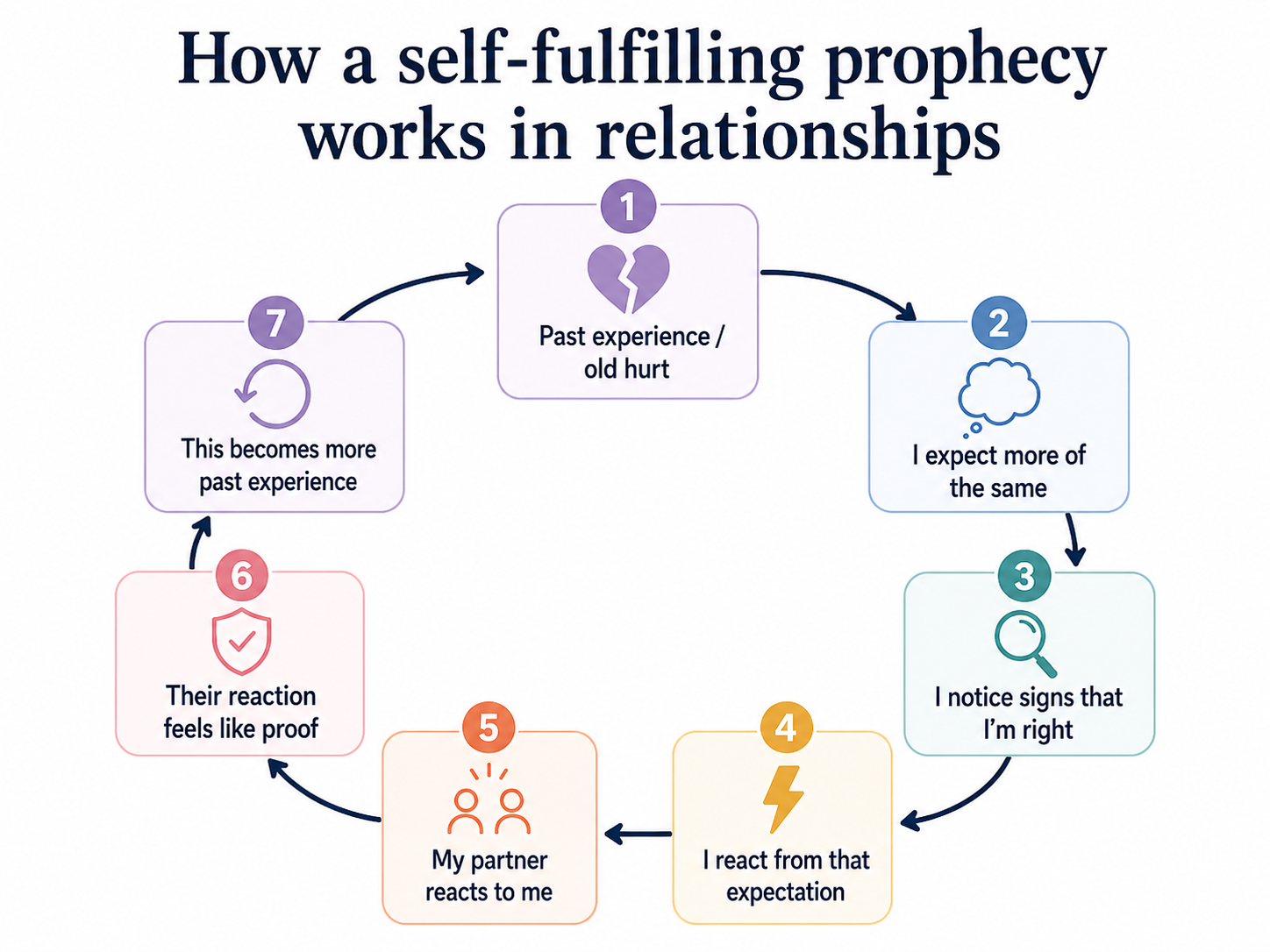
It starts with past experience. That might be past experience with our partner. But it could as likely be past experience with a previous partner or with a parent. We often seem to see our partners through the lens of someone who abused or failed us in the past.
The human brain is a sort of prediction machine, constantly anticipating what is likely to happen next. It also has a negativity bias. This is simply to keep us safe. That’s one of the brain’s central functions – protection.
So we notice evidence that fits the prediction.
We interpret any ambiguous behaviour according to our expectations.
And we tend not to notice evidence which contradicts the prediction.
Consequently we respond more to the prediction than what’s actually happening, and that response often plays out as criticism, blame or fear.
Of course our partner reacts to that response. People don’t like being blamed or criticised and most people don’t want to be feared either. So they react. Negatively.
Their reaction confirms our original prediction and the self-fulfilling prophecy is ‘proven’.
“See? I knew you’d do that.”
To quote an old maxim, “What the thinker thinks, the prover proves.”
When two prophecies clash
Let me give you a common example, which I encounter over and over in the couples I work with:
‘Karen’ tells me she feels unseen and unheard. “He never listens to me.”
Maybe ‘James’ isn’t a great listener. Most of us aren’t as good at listening as we think we are.
But because Karen feels unheard, she approaches all their interactions expecting not to be heard.
Maybe her tone is a little sharper. Perhaps she explains more, interrupts him before he’s finished speaking, so that he tries to get the floor back.
James feels criticised and either shuts down or rages.
This is a classic loop that couples enact. The more unheard she feels, the more she interrupts and criticises him, the more reactive he becomes and the less he listens.
And she tells me “He never listens.”
But she’s not the only caught up in the self-fulfilling prophecy. James has the same human brain with its predictive processing and negativity bias.
His self-fulfilling prophecy is “Whatever I do, she’ll criticise me.”
So when Karen starts to speak, he braces himself or withdraws. She feels ignored and pushes harder, and the more she pushes, the more he withdraws.
His response: “See? Nothing I do is ever enough.”
Now you’ve got the interlocking self-fulfilling prophecy.
The important distinction
There’s a key distinction here. It’s not that your partner’s behaviour is all in your head.
But rather that your expectations may be influencing the very interaction you’re using as evidence for those expectations.
We all do this:
We have some past experience which has shaped our expectations
We tend to predict more of the same
Our predictions and the negativity bias influence our perceptions of the other person’s behaviour
Our expectations and perceptions influence our own behaviour
Our behaviour draws out the very patterns we had predicted in our partner.
And all of this is working in both directions – from her to him and from him to her.
How can you stop a self-fulfilling prophecy in your relationship?
Move towards curiosity rather than fixing:
What am I expecting my partner to do?
What evidence am I looking for?
How might that expectation be affecting the way I’m showing up?
What might happen if I look out for the opposite of what I’ve been expecting?
If you’d like to understand the patterns you and your partner keep getting pulled into, and find a different way forward, you can book a discovery call here: Book a Clarity Call