- Aug 21
Beyond bubble baths: Moving from self-protection to self-care
- Sorrel Pindar
Sign up to get notified whenever I publish a post
“What does self-care even mean?” – it’s a good question, because the concept of self-care has been rather ruined by bubble baths, candles and spa days.
Self-care isn’t necessarily doing something nice for yourself – although there’s nothing wrong with doing the nice things. But real self-care involves learning to respond to yourself in ways that support you now and allow you to grow, rather than automatically using the strategies that you used to keep you safe in the past. Those strategies were often more about protecting yourself from the outside world than about caring for you.
For instance, a child at boarding school may learn that self-protection means don’t need, don’t feel, don’t ask, don’t depend. As an adult, genuine self-care may therefore feel surprisingly uncomfortable because it involves doing precisely those things: noticing needs, allowing feelings, asking for support and recognising that you matter.
So it might still look like self-care when we avoid a difficult conversation, but that’s more a case of self-protection. Self-protection may have been the best option available to us when we were only 10 years old. But now, as adults, we have more resources to draw on.
For me the most important aspect of self-care is self-compassion. This means being kind to yourself when you’ve made a mistake or messed up, instead of being disappointed in yourself or beating yourself up.
Moving from self-protection to self-care means learning new responses to familiar triggers. We may have been reacting to those triggers for years using programmes laid down in childhood. The table below provides some examples of what we’re talking about here.
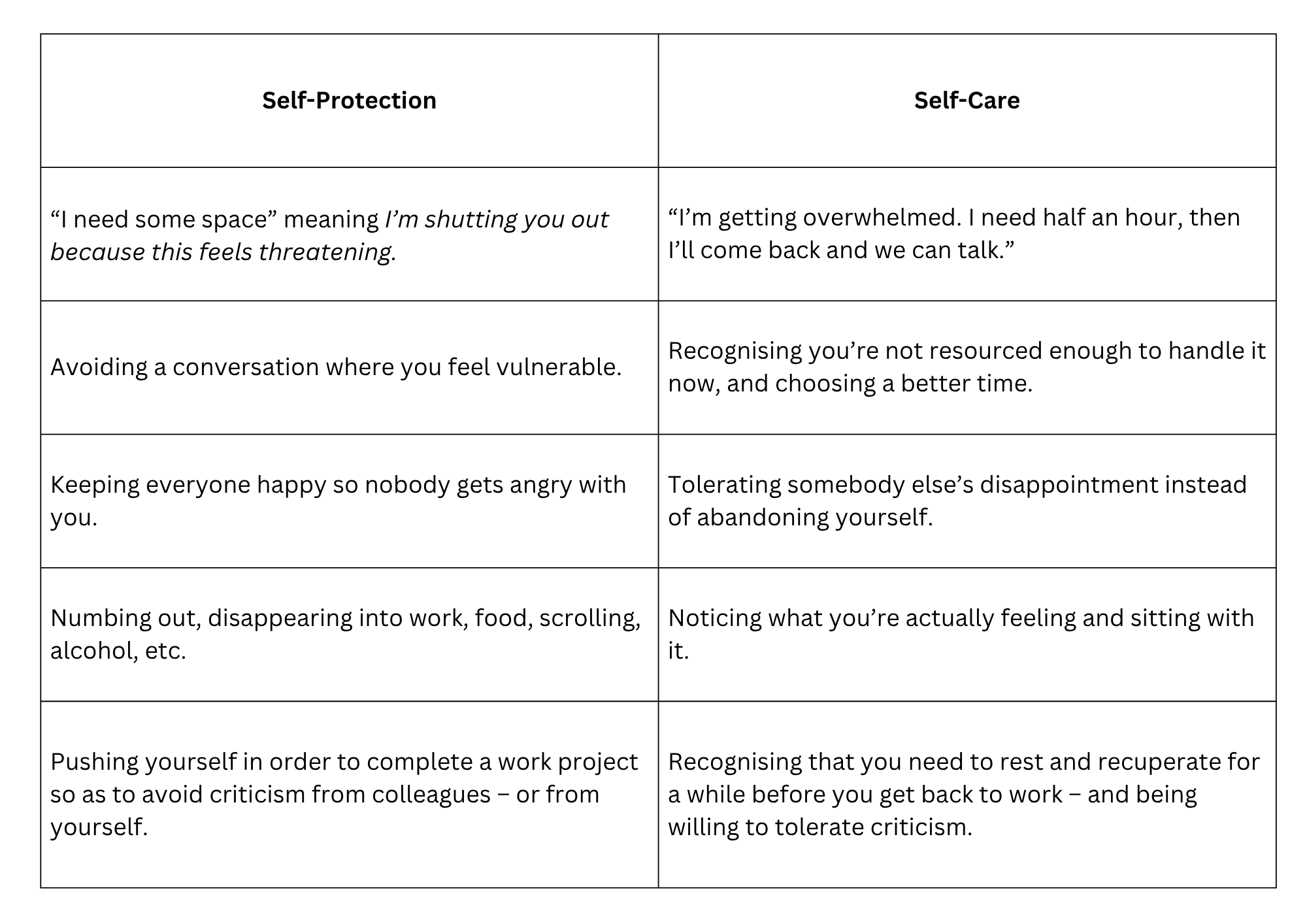
But self-care is also about respecting your own humanness. You occupy a human body with a human nervous system, and both have natural limits. This means being willing to meet the needs of your human system for rest, good food, exercise, time in nature, sleep, etc. Very often self-protection has meant not meeting those needs as we try to placate or people-please. For many of my clients it can be enormously challenging to put their own needs ahead of the needs of others.
This usually comes with poor boundaries both in allowing others to be intrusive and in finding it difficult to say ‘No’ when someone makes demands that are out of alignment or that exceed our resources.
Self-care also means doing what you can to settle your nervous system, so that life ceases to be like a roller-coaster as you careen from one trigger to another, from outburst to shutdown. This is where self-care starts to look like doing the deep inner work of facing the demons inside us and discovering that they are no longer as scary as they were when we were 10 years old.
Perhaps the most challenging aspect of self-care is saying “No.” Gabor Maté has written extensively about the possible relationship between chronic stress, self-suppression and physical illness. His argument is that when we continually suppress our own needs and our ability to say “No”, the effects may eventually be expressed through the body. It is, as Maté says, as if ‘the body says No.’
I said earlier that I believe that self-compassion is the most important aspect of self-care. Practising self-compassion allows us to approach the more challenging things, such as getting our own needs met, setting boundaries and saying “No” to whatever feels out of alignment.
Self-protection may consist of never saying “No” or equally it may take the opposite form: a fear of being controlled which can result in constantly refusing to give our partners what they need. A strange paradox perhaps, but it’s as if self-protection drives us to one pole or the other.
What if the behaviour that helped you survive is now the thing preventing you from taking care of yourself? And what would you like to change as you move from self-protection to self-care?
If like some support with moving from self-protection to self-care, book a Clarity Call. It costs nothing and you get my full attention for an hour.